


Fair Shine industrial (Hong Kong) Co., Limited
To provide customers with the most comprehensive precision mold parts solutions.

2026-07-02 09:43:21
Stamping molds are the foundation of modern metal manufacturing,enabling manufacturers to produce large quantities of precise metal components quickly and consistently.From automotive body panels and electronic connectors to household appliances and aerospace components,a stamping mold plays a crucial role in transforming flat metal sheets into functional parts with exceptional accuracy.
Understanding how a stamping mold works can help engineers,purchasing managers,and manufacturers choose the right tooling solution for their production needs.
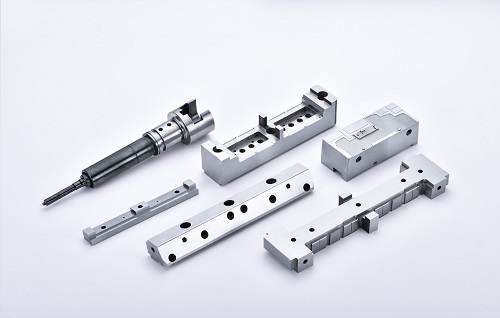
A stamping mold,also known as a metal stamping mold or precision stamping mold,is a specialized tool used in conjunction with a stamping press to cut,bend,punch,emboss,or form sheet metal into a desired shape.It is designed according to the dimensions and specifications of the final product,ensuring every part produced is nearly identical.
Modern custom stamping molds are manufactured with high-strength tool steel and Precision Machining techniques to withstand millions of production cycles while maintaining tight tolerances.
The working principle of a stamping die is straightforward but highly precise.
First,a sheet or strip of metal—such as stainless steel,aluminum,copper,or carbon steel—is fed into the stamping press.The material is accurately positioned between the upper and lower sections of the mold.
When the press operates,the upper die moves downward with significant force.The punch presses the metal into or through the die cavity,performing operations such as:
Blanking
Punching
Bending
Forming
Drawing
Coining
Embossing
After the operation is completed,the press retracts,and the finished part is automatically ejected or transferred to the next production stage.In high-volume manufacturing,progressive dies allow multiple forming processes to occur simultaneously as the material advances through different stations.
This automated workflow enables manufacturers to achieve remarkable production efficiency while maintaining excellent dimensional consistency.
A high-quality precision stamping mold generally consists of several key components:
The mold base provides structural support and ensures accurate alignment between the upper and lower die.
The punch applies pressure to the metal sheet,shaping or cutting it according to the Mold Design.
The die cavity determines the final geometry of the stamped component.
Guide Posts and Bushings
These components keep both mold halves perfectly aligned during every stamping cycle.
Springs provide return force,while strippers help remove the finished workpiece from the punch.
Together,these components ensure smooth,repeatable,and reliable production.
Modern metal stamping molds offer numerous advantages for industrial production:
High dimensional accuracy
Excellent repeatability
Long service life
High-speed mass production
Low production cost per part
Suitable for complex geometries
These features make stamping molds one of the most cost-effective manufacturing Solutions for medium-and high-volume production.
Different production requirements require different mold designs.
Completes one operation during each press stroke and is ideal for simple components.
Performs multiple operations in sequence as the metal strip advances through the mold.This design greatly improves production efficiency.
Executes multiple cutting operations simultaneously in one press stroke.
Moves the workpiece from one station to another,making it suitable for large and complex metal parts.
Choosing the right stamping die depends on production volume,product complexity,material type,and required precision.
Today,custom stamping molds are widely used across many industries.
They manufacture body panels,brackets,seat components,engine parts,battery housings,and structural reinforcements.
Stamping molds produce connectors,terminals,shielding cases,switch components,and precision electronic hardware.
Manufacturers use stamping molds to create washing machine parts,refrigerator panels,microwave components,and air conditioner accessories.
Precision metal parts used in surgical instruments and medical devices often rely on high-precision stamping molds.
Lightweight yet durable aircraft components are frequently manufactured using advanced stamping technology.
Investing in a quality precision stamping mold provides several long-term benefits.
First,it improves production consistency,reducing quality defects and rework.
Second,it shortens manufacturing cycles,helping companies meet growing market demand.
Third,it lowers production costs through automation and efficient material utilization.
Finally,precision tooling delivers superior surface finish and dimensional accuracy,making it ideal for industries with strict quality standards.
As manufacturing continues moving toward Industry 4.0,modern stamping molds increasingly integrate CAD/CAM design,CNC Machining,simulation software,and automated inspection systems to achieve even higher efficiency and reliability.
A:Common materials include stainless steel,aluminum,copper,brass,carbon steel,and galvanized steel.
A:The two terms are often used interchangeably to describe the tooling used in metal stamping processes.
A:With proper maintenance,a high-quality stamping mold can produce hundreds of thousands to several million parts.
A:Automotive,electronics,aerospace,medical devices,home appliances,and industrial equipment manufacturing.
A:Mold material,machining accuracy,heat treatment,design quality,lubrication,and regular maintenance all influence performance.

Fair Shine industrial (Hong Kong) Co., Limited
To provide customers with the most comprehensive precision mold parts solutions.
+86 189 2682 6341
Block 1, No. 12, Wusong 4th Street, Yuwu Industrial Zone, Dongcheng District, Dongguan, Guangdong, China
Copyright © 2026 Dongguan Huixiang Mold Technology Co., Ltd all rights reservrd.
Technical support: HuaShang