


Fair Shine industrial (Hong Kong) Co., Limited
To provide customers with the most comprehensive precision mold parts solutions.

2026-07-02 10:31:25
In modern manufacturing,stamping molds play a critical role in transforming flat metal sheets into precise functional parts used in everyday products.From automotive components to electronic connectors,the choice of mold type directly affects production efficiency,cost,and final product quality.Understanding the different types of stamping molds helps engineers and buyers select the right solution for their production needs.
This article explains the main categories of metal stamping molds,their working principles,features,and applications in real industrial environments.
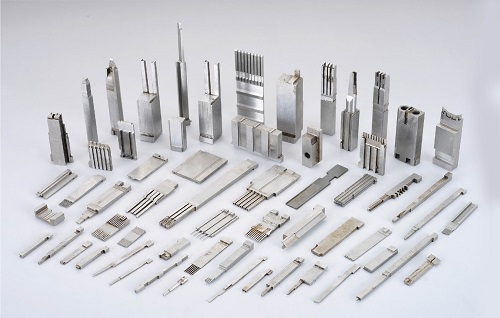
A stamping mold(also called a stamping die)is a precision tool used in a stamping press to cut,bend,form,or shape sheet metal.It works under high pressure and is designed for mass production,ensuring every part meets strict dimensional requirements.
Modern precision stamping molds are built using hardened tool steel and advanced CNC Machining to achieve long service life and consistent accuracy.
Different production needs require different mold structures.Below are the most commonly used types of stamping molds in the manufacturing industry.
A single-stage mold performs only one operation per press stroke,such as punching or cutting.
It is simple in structure and cost-effective,making it ideal for small-batch production or simple parts.
Features:
Low manufacturing cost
Easy maintenance
Suitable for simple geometry
Applications:
Basic metal brackets
Small Hardware Parts
Simple electronic components
This type is often the first choice for startups or low-volume production.
A progressive stamping mold is one of the most widely used systems in modern manufacturing.It performs multiple operations in a single continuous process as the metal strip moves through different stations.
Each station completes a different step such as punching,bending,or forming.
Features:
High efficiency and automation
Suitable for mass production
Stable product consistency
Applications:
Automotive connectors
Electrical terminals
Consumer electronics parts
Because of its efficiency,the progressive die is widely used in high-volume industries.
A compound mold performs multiple cutting operations in a single stroke.
Unlike progressive molds,all operations happen at one station.
Features:
High precision
Fast cycle time
Suitable for flat parts
Applications:
Washers
Small discs
Flat metal plates
This type is commonly used when accuracy is More important than complexity.
A transfer mold moves the workpiece from one station to another using mechanical arms or automation systems.
It is suitable for larger or more complex parts that cannot remain connected in strip form.
Features:
High flexibility
Suitable for complex shapes
Works with automation systems
Applications:
Automotive body parts
Large structural components
Appliance housings
The transfer die system is often used in large-scale industrial production.
A deep drawing mold is used to form hollow or deep-shaped components by strEtching metal sheets into a cavity.
Features:
Ideal for deep or curved shapes
Requires high material strength
Produces seamless structures
Applications:
Kitchen sinks
Fuel tanks
Beverage cans
This process is essential for industries requiring strong,seamless containers.
Across all types,metal stamping molds share several core functions:
Cutting sheet metal into precise shapes
Bending and forming complex geometries
Punching holes and openings
Creating embossed or textured surfaces
Supporting high-speed mass production
These functions make stamping molds essential for modern industrial manufacturing.
Investing in a high-quality precision stamping mold brings several long-term benefits:
High production efficiency
Excellent repeatability
Reduced material waste
Lower unit cost in mass production
Long service life with proper maintenance
In industries where consistency is critical,stamping molds offer unmatched stability compared to manual or CNC-only processes.
Today,stamping molds are widely used across global industries:
Used for brackets,structural parts,connectors,and body panels.
Used for terminals,shielding covers,connectors,and micro components.
Used in washing machines,refrigerators,air conditioners,and ovens.
Used for lightweight structural components requiring high precision.
Used in surgical tools and device housings requiring strict tolerances.
Selecting the right custom stamping mold depends on several factors:
Product complexity
Production volume
Material type(steel,aluminum,copper,etc.)
Required precision level
Budget and lifecycle expectations
For example,progressive molds are ideal for high-volume production,while single-stage molds are better for prototypes or small batches.
A:Progressive stamping molds are the most widely used due to their efficiency and suitability for mass production.
A:Progressive molds perform multiple steps across stations,while compound molds complete multiple operations in a single stroke.
A:Yes,custom stamping molds are designed based on product size,material,and production requirements.
A:Automotive,electronics,home appliances,aerospace,and medical industries.
A:With proper maintenance,a high-quality mold can last from hundreds of thousands to millions of stamping cycles.

Fair Shine industrial (Hong Kong) Co., Limited
To provide customers with the most comprehensive precision mold parts solutions.
+86 189 2682 6341
Block 1, No. 12, Wusong 4th Street, Yuwu Industrial Zone, Dongcheng District, Dongguan, Guangdong, China
Copyright © 2026 Dongguan Huixiang Mold Technology Co., Ltd all rights reservrd.
Technical support: HuaShang