


Fair Shine industrial (Hong Kong) Co., Limited
To provide customers with the most comprehensive precision mold parts solutions.

2026-07-16 14:56:40
A Die Casting mold is a precision manufacturing tool designed to transform molten metal into complex components with high accuracy and consistent quality.It works by forcing liquid metal into a specially designed mold cavity under high pressure,where the material cools and solidifies into the desired shape.
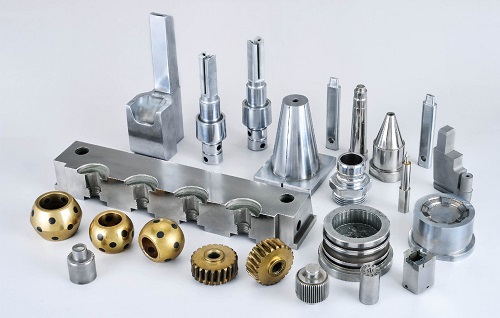
The working principle of a Die Casting mold involves four major stages:
Mold preparation and closing
Molten metal injection
Cooling and solidification
Part ejection and mold reuse
Through this repeated cycle,manufacturers can produce thousands or even millions of identical metal parts efficiently.
The basic principle behind a die casting mold is controlled shaping through pressure and precision tooling.
Unlike gravity casting,where molten metal simply flows into a mold,die casting uses high injection pressure to force molten metal into small and complex areas of the cavity.
This high-pressure process allows manufacturers to produce parts with:
Thin walls
Complex geometries
Tight dimensional tolerances
Smooth surface finishes
The mold acts as a temporary forming chamber that controls the final shape of the metal component.
Before the casting cycle begins,the two halves of the die casting mold are securely closed.
A typical mold consists of:
Fixed die half
Moving die half
Mold cavity
Core pins
Ejector system
Cooling channels
When both mold halves are locked together,they create a sealed cavity that matches the design of the final product.
Proper mold alignment is essential because even small positioning errors can cause:
Flash defects
Dimensional inaccuracies
Poor surface quality
After the mold is closed,molten metal is injected into the cavity under high pressure.
Common die casting materials include:
Aluminum alloys
Zinc alloys
Magnesium alloys
During injection,the metal flows through:
Sprue
Runner system
Gate
Mold cavity
The high injection speed allows the molten material to completely fill complex sections before solidification begins.
After filling the cavity,the molten metal starts cooling and becoming solid.
The cooling process is controlled by internal cooling channels built into the mold.
An optimized cooling system helps:
Maintain stable mold temperature
Reduce cycle time
Improve part strength
Prevent shrinkage defects
The quality of cooling directly affects the final casting performance.
Once the metal component has fully solidified,the moving mold half separates from the fixed half.
The ejector system then pushes the finished part out of the mold.
The ejection system usually includes:
Ejector pins
Ejector plates
Return pins
A well-designed ejection system prevents:
Part deformation
Surface damage
Sticking problems
After removal,the mold closes again and begins another production cycle.
The mold cavity determines the shape and size of the final casting.
High-Precision Machining ensures:
Accurate dimensions
Smooth surfaces
Consistent production results
Die cast core pins are important components used to create internal holes,channels,and hollow structures.
Because they operate under extreme heat and pressure,core pins require materials with:
High hardness
Heat resistance
Wear resistance
Common materials include:
H13 tool steel
SKD61 steel
Tungsten carbide
Cooling channels regulate the temperature of the die casting mold during production.
Effective cooling design helps:
Extend mold lifespan
Improve production efficiency
Reduce casting defects
Poor cooling may lead to:
Cracks
Uneven shrinkage
Shorter mold life
The ejection system removes the finished casting safely after cooling.
It must provide enough force while avoiding damage to the product surface.
Pressure is one of the most important factors in the die casting process.
High-pressure injection allows molten metal to:
Fill narrow cavities
Reproduce fine details
Produce thinner walls
Improve surface quality
Without sufficient pressure,problems may occur,such as:
Incomplete filling
Air pockets
Poor dimensional accuracy
The performance of a die casting mold directly influences the final product.
A well-designed mold improves:
Precision Machining ensures every produced part meets required specifications.
A high-quality cavity produces smoother casting surfaces with fewer defects.
Durable molds support faster cycle times and longer operating life.
Reliable molds reduce:
Material waste
Machine downtime
Maintenance costs
Aluminum molds are widely used for lightweight and strong components.
Applications include:
Automotive parts
Engine housings
Electronic cases
Heat sinks
Zinc molds are suitable for smaller and highly detailed parts.
Applications include:
Hardware products
Precision components
Decorative parts
High-pressure molds are designed for large-scale production requiring high repeatability.
The material determines resistance to:
Heat fatigue
Wear
Mechanical stress
Common choices include H13 and SKD61 tool steels.
Good mold design should consider:
Metal flow
Cooling layout
Ejection structure
Part release
Regular maintenance helps prevent:
Cracking
Surface damage
Reduced production quality
Proper cleaning,lubrication,and inspection can significantly extend mold life.
| Feature | Die Casting Mold | Injection Mold |
|---|---|---|
| Material | Molten metal | Plastic resin |
| Temperature | Extremely high | Lower |
| Pressure | Very high | Moderate to high |
| Main Challenge | Heat and thermal fatigue | Wear and pressure |
| Applications | Metal components | Plastic products |
A die casting mold shapes molten metal into precise components during high-pressure casting production.
A high-quality die casting mold can usually produce hundreds of thousands of parts depending on material,design,and operating conditions.
Common materials include H13 tool steel,SKD61 steel,and other heat-resistant alloy steels.
High pressure helps molten metal fill complex cavities quickly and improves dimensional accuracy and surface quality.
Yes.Professional manufacturers can customize mold designs,cavity structures,core pins,cooling systems,and dimensions according to customer requirements.

Fair Shine industrial (Hong Kong) Co., Limited
To provide customers with the most comprehensive precision mold parts solutions.
+86 189 2682 6341
Block 1, No. 12, Wusong 4th Street, Yuwu Industrial Zone, Dongcheng District, Dongguan, Guangdong, China
Copyright © 2026 Dongguan Huixiang Mold Technology Co., Ltd all rights reservrd.
Technical support: HuaShang